Understanding Pet Toy Safety Standards: CPSIA, EN71, and REACH

In August 2025, Petmate recalled 15,000 Pet Zone Laser Pointer & LED Ball pet toys from Menards shelves nationwide. The reason wasn't a manufacturing defect. It was six button-cell batteries that violated Reese's Law, the federal standard for consumer products with coin and button batteries. The CPSC warning was blunt: "risk of serious injury or death from ingestion hazard."
Petmate is a major brand. They've been in this industry for decades. And they still got caught.
If you're an importer sourcing plush squeaky toys, rope tugs, or treat-dispensing puzzle balls from a factory in Ningbo or Dongguan, that recall should make you uncomfortable. Because the gap between "my supplier says it's safe" and "this product is legally compliant in my target market" is where every recall lives.
This article walks through the three regulatory frameworks that matter most for pet toys sold in North America and Europe: CPSIA, EN71, and REACH. I'll explain what each covers, who needs to comply, and how to prepare for testing so you don't burn five figures on failed lab reports.
Why Compliance Isn't Optional (Even for Pet Toys)
Some buyers assume pet toys skate under the radar because they're for dogs, not children. That assumption is expensive.
In the US, the CPSC doesn't have a dedicated "pet toy" category. If a toy is marketed for pets but a child could reasonably play with it, the CPSC can classify it as a children's product. A plush squeaky bone with googly eyes and pastel fabric? A rubber treat ball in bright primary colors? Any of these can trigger CPSIA jurisdiction. And once that happens, you're on the hook for the full battery of testing, tracking labels, and Children's Product Certificates.
In the EU, the picture is similar. The Toy Safety Directive 2009/48/EC defines a toy as a product "designed or intended, whether or not exclusively, for use in play" by children under 14. If your pet toy looks like a stuffed animal or makes sounds that appeal to kids, a market surveillance authority can flag it. And they do.
The safe play: treat every pet toy you import as if it will be tested against the strictest standard in your target market. If a regulator or a retailer's compliance team decides to test it, that's exactly the standard they'll apply.
CPSIA: What It Covers and Who Needs It
The Consumer Product Safety Improvement Act of 2008 is the backbone of US product safety law for children's products. For pet toys classified as children's products, here's what you're signing up for.
Lead Content and Surface Coatings
CPSIA sets hard limits on lead. Total lead content in any accessible substrate — fabric, plastic, stuffing, the squeaker housing — cannot exceed 100 parts per million (ppm). Surface coatings (paint, ink, screen printing) are capped at 90 ppm.
If you're printing a logo on a plush toy with standard screen-printing ink, you need to know the lead content of that ink. I've seen batches where the fabric passed and the printed graphic failed because the factory switched ink suppliers mid-run and nobody told the buyer.
Phthalates
Eight phthalates are permanently restricted in children's toys under CPSIA Section 108. DEHP, DBP, and BBP are capped at 0.1% (1,000 ppm) each. DINP, DIDP, DnOP, DIBP, and DPENP carry the same limit for mouthable toys and childcare articles. For pet toys, phthalates creep in through softened PVC components — that translucent squeaker bulb, the flexible vinyl in a treat-dispensing shell. If the factory uses off-the-shelf PVC from a sub-supplier you've never visited, that's a phthalate risk you need to control.
ASTM F963-23
CPSIA incorporates ASTM F963 by reference, making it mandatory. The current version, ASTM F963-23, became enforceable in April 2024. Key sections for pet toys:
- Mechanical/physical hazards: small parts, sharp points, seams on plush toys, torque and tension tests on attached components (eyes, noses, squeakers)
- Flammability: surface flash tests on fabric, especially relevant for long-pile fur
- Heavy elements: migration limits for 8 elements (antimony, arsenic, barium, cadmium, chromium, lead, mercury, selenium) via soluble extraction
- Sound: decibel limits for squeakers and electronic modules
- Battery accessibility: the clause that bit Petmate — button/coin batteries must be secured in a tool-requiring compartment and pass abuse testing
CPC and Tracking Labels
After testing, you produce a Children's Product Certificate (CPC). You sign it. Not the factory, not the lab. It lists each applicable regulation, test dates, and the CPSC-accepted lab's details. You also need a tracking label permanently affixed to the product and packaging, identifying the manufacturer, production date and location, and batch/lot number. If you can't trace a defective unit back to the factory line shift that made it, your tracking system isn't good enough.
What Testing Costs
Full CPSIA suite (lead, phthalates, ASTM F963 mechanical/physical, flammability, heavy elements): roughly $1,800–$3,500 per SKU at a US-based CPSC-accepted lab. A rope tug sits at the low end; an electronic treat puzzle with multiple materials pushes the high end. Component part testing can reduce total cost. If ten SKUs share the same squeaker, you test it once and reference that report across all ten CPCs.
EN71: The European Standard
If you're selling into the EU, EN71 is the harmonized standard under the Toy Safety Directive 2009/48/EC. Compliance with EN71 is your route to the CE mark.
EN71-1: Mechanical and Physical Properties
Covers small parts (the cylinder test is similar to ASTM F963 but with slightly different dimensions), sharp edges, sharp points, seam strength, stuffing accessibility, cords and drawstrings, and structural integrity after drop, torque, and tension tests. For plush pet toys, the seam-strength and stuffing-accessibility tests matter most. If a toy fails the 70-N seam test for products intended for children under 36 months, it won't reach EU shelves.
EN71-2: Flammability
Bans outright flammable materials like celluloid and sets surface flash-time limits: flame must not spread faster than 30 mm/s across textile surfaces. Soft-filled toys with pile surfaces have additional requirements: the surface flash test is done on the fur face, and the toy must not ignite or flash across its surface.
EN71-3: Migration of Certain Elements
This is where EN71 diverges from CPSIA. Rather than measuring total content, EN71-3 simulates stomach-acid leaching. Migration limits cover 19 elements (versus 8 under ASTM F963), including aluminum, boron, cobalt, nickel, strontium, tin, organic tin, and zinc. These are elements CPSIA doesn't test for. Limits vary by material category: the lead migration limit is 2.0 mg/kg in scraped-off materials, 0.5 mg/kg in liquids, and 13.5 mg/kg in dry/brittle materials. Different methodology, different thresholds, not interchangeable with CPSIA.
Other Relevant Parts
- EN71-9: organic chemical compounds (flame retardants, colorants, primary aromatic amines, solvents). Relevant for dyed fabrics and printed graphics
- EN71-12: N-nitrosamines and N-nitrosatable substances in rubber/elastomer components like squeakers and rubber balls
CE Marking and DoC
You produce a Declaration of Conformity (DoC) listing the product, applicable directives and standards, and your company's details. Unlike a CPC, the DoC doesn't require a CPSC-accepted lab. But using a non-accredited lab is a gamble. The new EU Toy Regulation (EU) 2025/2509 introduces mandatory third-party conformity assessment for certain categories and a digital product passport. Watch this if you're selling in the EU beyond 2027.
REACH: It's Not a Toy Regulation, But It Hits Pet Toys Hard
REACH — Regulation (EC) No 1907/2006 — is EU-wide chemical safety law. It doesn't target toys. It targets everything sold in the EU. For pet toy importers, REACH matters because it restricts substances that commonly appear in toy materials.
SVHCs: The Candidate List
The Substances of Very High Concern (SVHC) Candidate List, maintained by ECHA, contains approximately 240 substances (as of the January 2024 update). If your product contains more than 0.1% w/w of any SVHC, you must provide information about safe use to customers within 45 days of a request. Common SVHCs in pet toys: certain phthalates, lead compounds, cadmium compounds, azo dyes that break down into carcinogenic aromatic amines, and PAHs found in rubber and plastic materials.
REACH Annex XVII Restrictions
Separate from SVHCs, Annex XVII lists outright restrictions:
- Phthalates (Entry 51): DEHP, DBP, BBP, and DIBP capped at 0.1% individually or combined in any plasticized material in any article. This is broader than CPSIA because it applies to all articles, not just children's products
- PAHs (Entry 50): benzo(a)pyrene and other carcinogenic PAHs restricted to 1 mg/kg in rubber/plastic components with prolonged skin contact
- Azo dyes (Entry 43): aromatic amines from azo colorants restricted to 30 mg/kg in textiles
- Cadmium (Entry 23): restricted to 100 mg/kg in plastics
- Lead (Entry 63): 0.05% (500 mg/kg) in articles supplied to the general public
REACH vs EN71-3
EN71-3 tests migration under the Toy Safety Directive for 19 elements. REACH Annex XVII restricts total content for specific substances in all consumer articles. Both can apply to the same product. A rubber dog toy sold in the EU must satisfy EN71-3 migration limits and REACH Annex XVII total-content thresholds. Missing either one means non-compliance.
CPSIA vs EN71 vs REACH: Side-by-Side
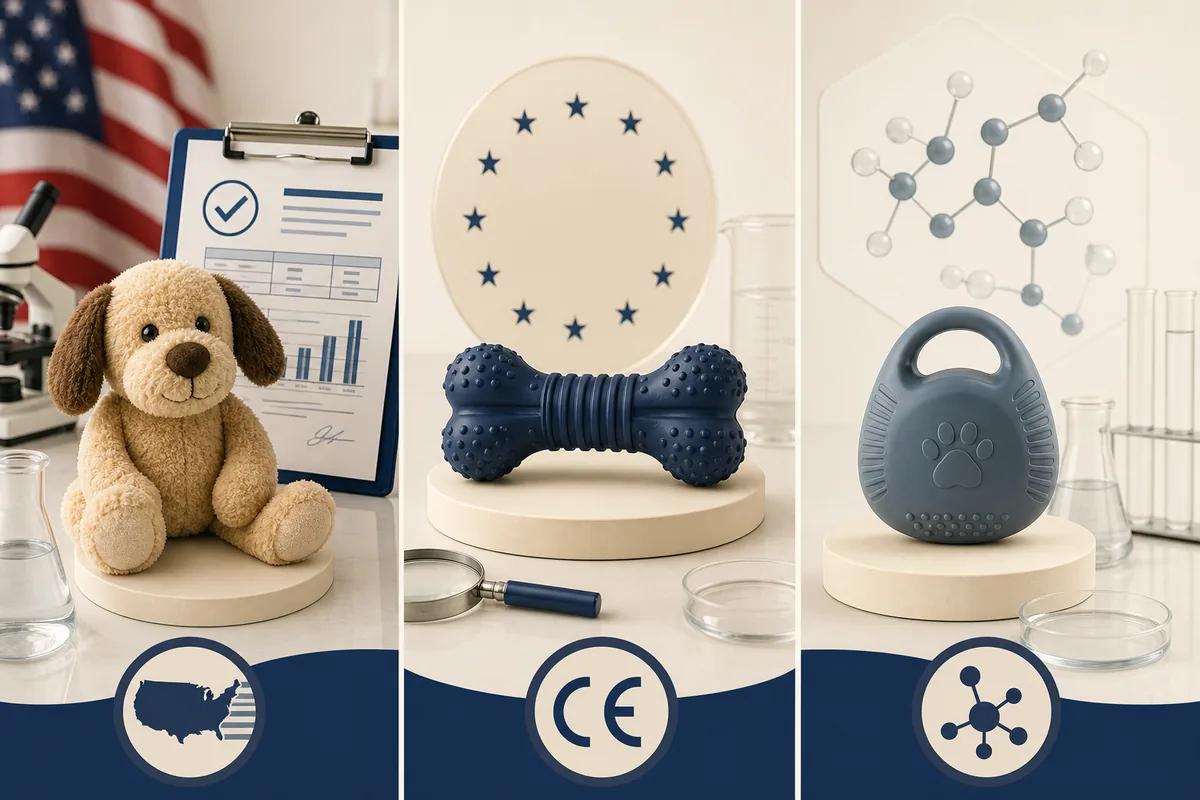
| Area | CPSIA (US) | EN71 (EU) | REACH (EU) |
|------|-----------|-----------|-----------|
| Scope | Children's products | Toys for children under 14 | All consumer articles |
| Lead | Total: 100 ppm substrate / 90 ppm coating | Migration: 2.0–13.5 mg/kg (EN71-3) | Total: 500 mg/kg (Annex XVII) |
| Phthalates | 0.1% each (DEHP/DBP/BBP); plus DINP/DIDP/DnOP for mouthables | Covered under EN71-9 and TSD chemical requirements | 0.1% combined in plasticized materials — all articles |
| Heavy Elements | 8 elements via soluble extraction (ASTM F963) | 19 elements via migration (EN71-3) | Varies by element and Annex XVII entry |
| Mechanical/Physical | ASTM F963-23 (small parts, seams, torque/tension, sound) | EN71-1 (small parts, seams, cords, drop/torque/tension) | Not applicable |
| Flammability | ASTM F963-23 Section 4 | EN71-2 (30 mm/s max; ban on celluloid) | Not applicable |
| Lab Requirement | CPSC-accepted third-party lab (mandatory) | No mandatory accreditation (but de facto requirement) | No specified accreditation |
| Certificate | Children's Product Certificate (CPC) | Declaration of Conformity + CE mark | Technical documentation |
| Tracking | Tracking label mandatory | Traceability required, no prescribed format | Not required |
How to Prepare for Lab Testing (Without Wasting Money)
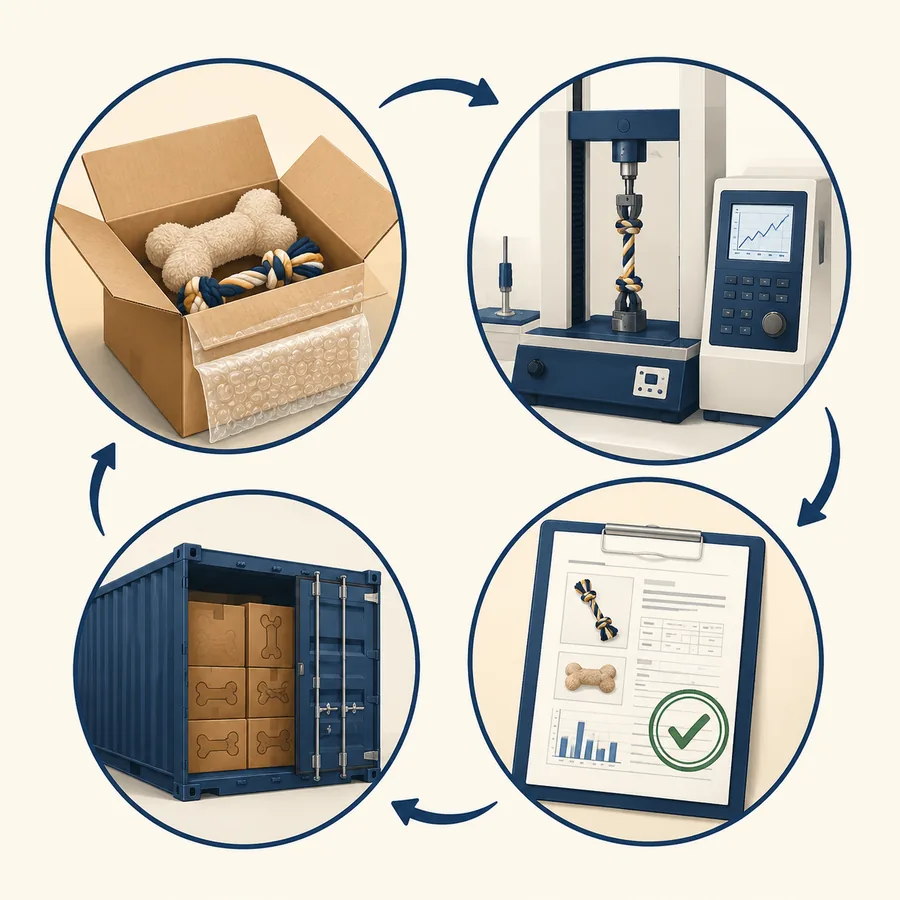
I've been on the factory floor at 2 AM trying to figure out why a batch failed migration testing three days before a container was supposed to sail. Here's what I learned.
Before You Prototype
Ask your factory for material data sheets for every component: fabric supplier, plastic pellet grade, ink batch, stuffing fiber, squeaker mechanism. If the factory can't produce these, or the sheets are handwritten in Chinese with no batch numbers, walk away. A competent factory with export experience will have them ready.
Specify your target standards in the purchase order. Don't write "EN71 compliant." Write "EN71-1:2014+A1:2018, EN71-2:2020, EN71-3:2019+A1:2021 compliant. REACH Annex XVII compliant for Entries 23, 43, 50, 51, 63." That specificity gives your QC inspector a concrete checklist.
Pre-Production Testing
Send pre-production samples to a CPSC-accepted or ISO 17025-accredited lab before authorizing mass production. Pre-production screening typically costs $800–$1,500 versus $2,000–$3,500 for full certification. If the sample fails lead content because the fabric dye contains lead chromate, you'd rather learn that before manufacturing 5,000 units.
Component Testing Strategy
If five plush SKUs share the same squeaker and stuffing, test those components once and reference the reports across all CPCs/technical files. This can reduce your testing budget by 40–60% across a product line.
During Production
Have your QC inspector pull random samples for pre-shipment testing, not just certification samples the factory selects. Pull at least 3 units per SKU for lab submission, plus 2 for in-house destructive testing: cut seams open, torque-test attached components, check stuffing. You'll spot 80% of potential failures before the lab sees them.
Build Your Technical File
A solid file saves you when a retailer's compliance team or EU market surveillance authority asks questions. Include: product description, BOM with material grades, supplier declarations, lab reports, CPC/DoC, batch records with lot traceability, and photos of the product, packaging, and tracking labels per lot.
FAQ
Do pet toys need CPSIA compliance?Only if the CPSC classifies the product as a children's product. In practice, any plush, colorful, or squeaky pet toy a child would pick up and play with should be treated as one. Importer beware.
What's the difference between "pet toy" and "dog chew" under EN71?A hard nylon or rawhide chew designed solely for gnawing probably falls outside the Toy Safety Directive. A squeaky plush bone with embroidered eyes sits in the gray zone. Treat it as a toy.
How long does lab testing take?Full CPSIA suite: 10–15 business days standard, 5–7 days expedited (30–50% surcharge). REACH SVHC screening: 7–10 days. Budget six weeks from sample submission to final report for a first-time product.
Can I use the same test report for CPSIA and EN71?No. Methodologies, limits, and required lab accreditations differ. You need separate testing for each framework.
What if my product fails?Identify the failed substance and its source, work with your factory to source a compliant alternative, and retest. Material substitution on a plush toy (e.g., switching to phthalate-free PVC for a squeaker) typically adds $0.05–$0.15 per unit at 5,000+ quantity. That's cheap compared to a recall.
The Bottom Line
Compliance isn't a box you check at the end of product development. It's a constraint you design in from material sourcing. The importers who get burned treat testing as a formality. They trust a supplier's verbal assurance and ship without a third-party report.
At WagNab, every product in our [catalog](/products) ships with full documentation — CPSC-accepted test reports for the US, EN71 and REACH Annex XVII compliance for the EU. We test during pre-production, re-test when materials change, and don't ship until reports are clean.
If you're sourcing pet toys and want to talk compliance — what standards apply to your product, which labs to use, how to build a technical file that holds up — [reach out to our ODM team](/odm). We've been in these factories. We know the material supply chains. And we'd rather you get it right the first time.
This article provides general guidance based on regulatory frameworks as of mid-2026. It is not legal advice. Verify current requirements with an accredited testing laboratory or qualified compliance professional before placing orders.
Ready to Build Your Next Collection?
From material selection to final delivery, we help brands bring pet toys to market.