Pet Toy Design Trends: What Is Shaping the Industry

Three years ago, a standard squeaky hedgehog in four colors was a perfectly viable SKU. You'd order 5,000 units, slot it into your catalog, and it'd sell through without much drama. That product still moves — but it's no longer enough to anchor a collection.
What changed isn't the dog. It's the owner.
The 2020–2022 adoption wave brought millions of first-time pet owners into the market. These aren't the same buyers who grabbed a rope bone off the endcap at Petco in 2018. They researched breeds before adopting. They follow veterinary behaviorists on Instagram. They know what "canine enrichment" means, and they expect the toys they buy to do more than squeak.
I've spent the last eight months visiting factories in Ningbo, Ho Chi Minh City, and Dongguan, reviewing spec sheets from two dozen brands, and sitting through buyer meetings where line plans for Q3 2026 got torn apart and rebuilt around new expectations. Here are the four design trends that actually have purchase orders behind them — not just Pinterest boards.
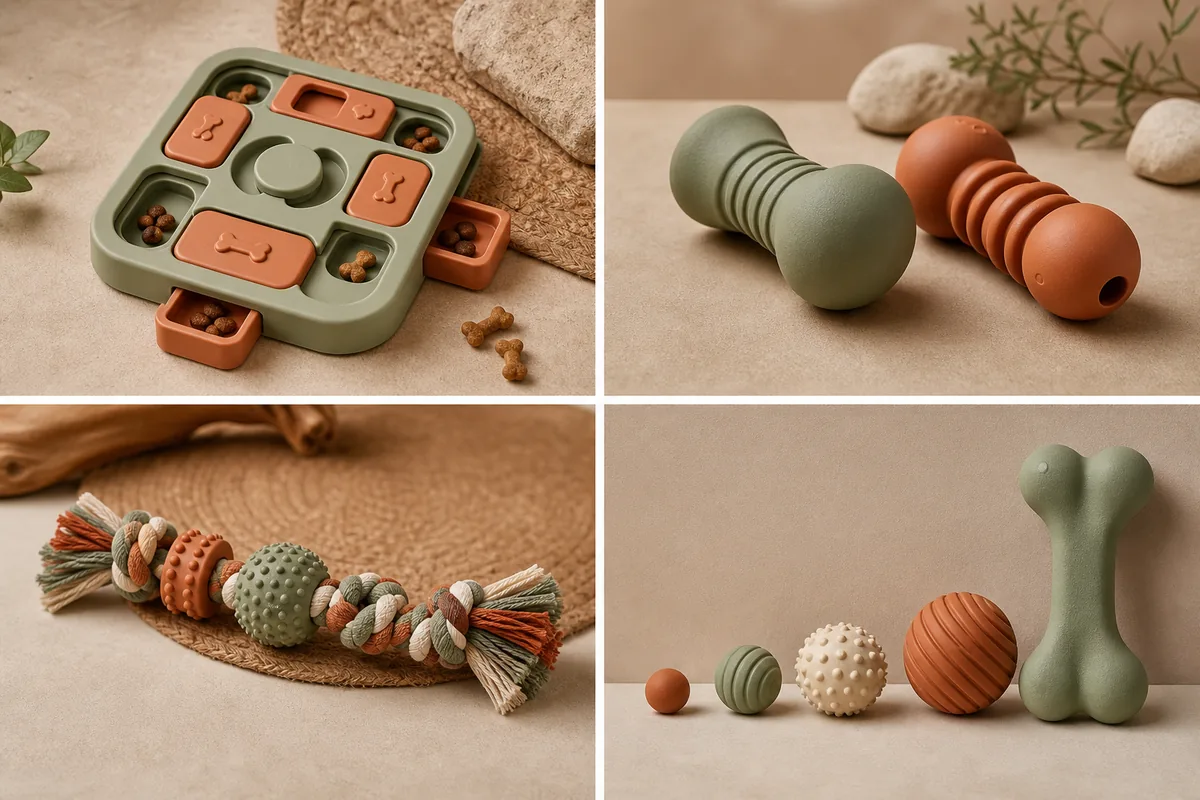
Trend 1: Puzzle and Enrichment Toys Are Eating the Category
Enrichment toys stopped being a niche subcategory roughly 18 months ago. They're now the category driver.
Chewy's in-house data (shared at Global Pet Expo 2025) showed enrichment-labeled toys growing 47% year-over-year, compared to 11% for traditional plush. PetSmart added a dedicated "Brain & Play" endcap in 1,600 stores. The shift isn't subtle.
What makes a toy an "enrichment" toy at the manufacturing level comes down to a few specific design mechanics:
Treat-dispensing puzzles with adjustable difficulty. Not the basic ball-with-a-hole design that's been around since 1999. We're seeing compartmentalized puzzles where the dog has to slide, flip, and rotate multiple mechanisms in sequence. One factory I visited in Dongguan is producing a three-layer puzzle feeder with six sliding compartments and two different difficulty inserts. Their order volume for that single SKU hit 140,000 units in the first half of 2026, split across four private-label brands. Snuffle mats and foraging toys with variable pile heights. The original snuffle mat — a rubber base with fleece strips — has evolved. Current designs use mixed fabric lengths (15mm, 25mm, and 40mm) in the same mat, plus hide-and-seek pockets sewn between layers. Durability matters here. The fleece needs to survive machine washing at 40°C without shredding. If your factory's fleece supplier can't provide wash-test results past 20 cycles, you'll see returns within the first quarter. Nina Ottosson-style interactive puzzles set the ceiling for what premium buyers expect. Outward Hound's licensing of Ottosson's designs normalized puzzles at the $19.99–$34.99 price point. The mechanics (sliding discs, flip-up compartments, removable bone-shaped locks) require injection-molded components with consistent tolerances. A 0.3mm variance in a sliding track means the disc sticks. Ask your factory about their mold maintenance schedule — cavities that have run 100,000+ shots without refurbishment produce the slop that gets you one-star reviews. One number to keep in your back pocket: the average enrichment toy commands a 22–35% price premium over an equivalently-sized traditional toy made from the same base materials. That margin covers the additional assembly labor and mold complexity. For a plush puzzle toy with three hidden squeaker pockets and a treat pouch, FOB cost runs roughly $2.80–$3.50 per unit at 3,000-piece MOQ, compared to $1.80–$2.20 for a same-size standard plush. Most brands absorb that delta because the retail price tolerance is higher and the reorder rate is stickier — dogs engage with puzzle toys longer, and owners perceive higher value.If your 2027 catalog doesn't have at least two enrichment SKUs, you're leaving shelf space open for a competitor who read the same category data.
Trend 2: Minimalist Aesthetics Are Winning Retail Shelf Space
Walk the toy aisle at a specialty pet retailer in 2026 and you'll notice something missing: the neon orange and electric purple that dominated packaging five years ago. The color story has shifted hard toward muted earth tones, tonal palettes, and designs that photograph well in a sunlit living room.
This isn't about what dogs like. Dogs see blue and yellow best, and they don't care about your brand aesthetic. This is about a buyer demographic that posts their home on Instagram and doesn't want a traffic-cone-red rubber bone clashing with their beige sectional.
The Pantone Effect
Brands are increasingly building color stories around specific Pantone references, and retailers are responding. The palettes moving fastest through distribution right now:
- Warm neutrals: Pantone 14-1118 TCX (Beige), 16-1334 TCX (Tan), 17-1223 TCX (Praline). These read as "premium" on shelf and photograph well on e-comm. One brand I work with switched their entire rubber toy line from primary colors to a terracotta/sand/olive palette and saw 17% lift in Chewy conversion rate within 60 days.
- Muted botanicals: Pantone 16-0229 TCX (Trellis Green), 16-0521 TCX (Desert Sage), 18-0416 TCX (Deep Olive). These sit alongside the "natural ingredient" positioning that dominates treat packaging and create cross-category cohesion.
- Dusty pastels: Pantone 14-3206 TCX (Pastel Lavender), 13-5304 TCX (Cooling Spray), 12-5403 TCX (Blue Flower). Still playful, but desaturated enough that the toy doesn't scream "cheap" on a retail peg.
Manufacturing these colors isn't just a pigment swap. Rubber compounds show base undertones at lower pigment loads — a "cream" TPR formula can pull yellow or gray depending on the base resin. Cotton rope takes dye differently by ply count and twist density. If your factory can't provide Pantone-matched lab dips before production, expect batch-to-batch color drift that retailers flag on reorders.
Form Follows Function — Quietly
Minimalist aesthetics also mean cleaner silhouettes. Less is more — fewer appliquéd eyes, less contrast stitching, simpler shapes that read as intentional rather than busy. A rope tug with a single dip-dyed end in terra cotta. A rubber chew in solid sage with a subtle texture pattern. A plush with one accent color instead of five.
The takeaway for product development: lead with two to three colorways per SKU — a neutral, a muted botanical, and one dusty pastel. Skip the brights unless you're designing specifically for the value-tier mass channel where color saturation still signals "fun" to a different buyer.Trend 3: Multi-Texture and Multi-Function Toys
Dogs don't experience toys the way humans do. A plush that looks cute on your website is evaluated by a dog through mouthfeel, resistance, sound, and shreddability. Multi-texture designs acknowledge that a single toy can serve multiple sensory needs, which extends engagement and justifies higher pricing.
The Texture Stack
The most common multi-texture combinations I'm seeing on factory spec sheets:
- Rope + Rubber. A cotton-poly blend tug body with injection-molded TPR end caps. The rope satisfies the shredding/gnawing instinct. The rubber provides bounce and a different mouthfeel. Manufacturing challenge: getting the mechanical bond between textile and TPR to survive a 35-pound dog's sustained tugging. Chemical adhesion alone fails. The TPR needs to be molded through the rope structure — braided loops or knotted ends that the TPR encapsulates during injection. If your factory proposes adhesive-only bonding, pass.
- Plush + Crinkle + Squeaker. Outer fabric for cuddling, internal crinkle material for auditory stimulation, plus one or two squeakers for reward. The construction sequence matters here. Stuff the crinkle before inserting squeakers — if the crinkle layer sits between the squeaker and the outer fabric, the sound dampens to near-uselessness. The best factories build these from the inside out, with crinkle layered directly against the outer shell seam.
- Rubber + Nylon. A durable nylon chew core with over-molded rubber texture rings. This combination works for aggressive chewers who destroy plush in 10 minutes but get bored with plain nylon bones. The nylon core provides structural integrity; the rubber rings add texture variety and a softer bite surface. Retail price points on these run $14.99–$22.99, with FOB costs at $3.40–$5.20 per unit depending on nylon grade and ring count.
One Toy, Multiple Functions
Beyond texture, function stacking is the other dimension. A toy that squeaks is a toy. A toy that squeaks, dispenses kibble, and floats for water retrieval is three products in one SKU — and owners notice.
I reviewed a prototype last month from a factory in Ningbo: a floating treat-dispensing tug with a squeaker module in the center cavity. The dog can tug it (rope handles on each end), chase it (it floats and bounces erratically in water), and work for food (treat compartment accessible through side slits). The unit cost is roughly $4.80 FOB at 5,000 units. The brand plans to retail it at $27.99. That's nearly 6x landed cost — entirely justifiable when the buyer gets three discrete use cases in one product.
Concrete data point: multi-function toys carry return rates 40% lower than single-function plush, per data shared by a mid-market brand I consult for. Owners keep them around longer. That means better reviews, stronger repeat purchase behavior, and fewer chargebacks from retailers who track RTV rates obsessively.Trend 4: Size-Inclusive Design
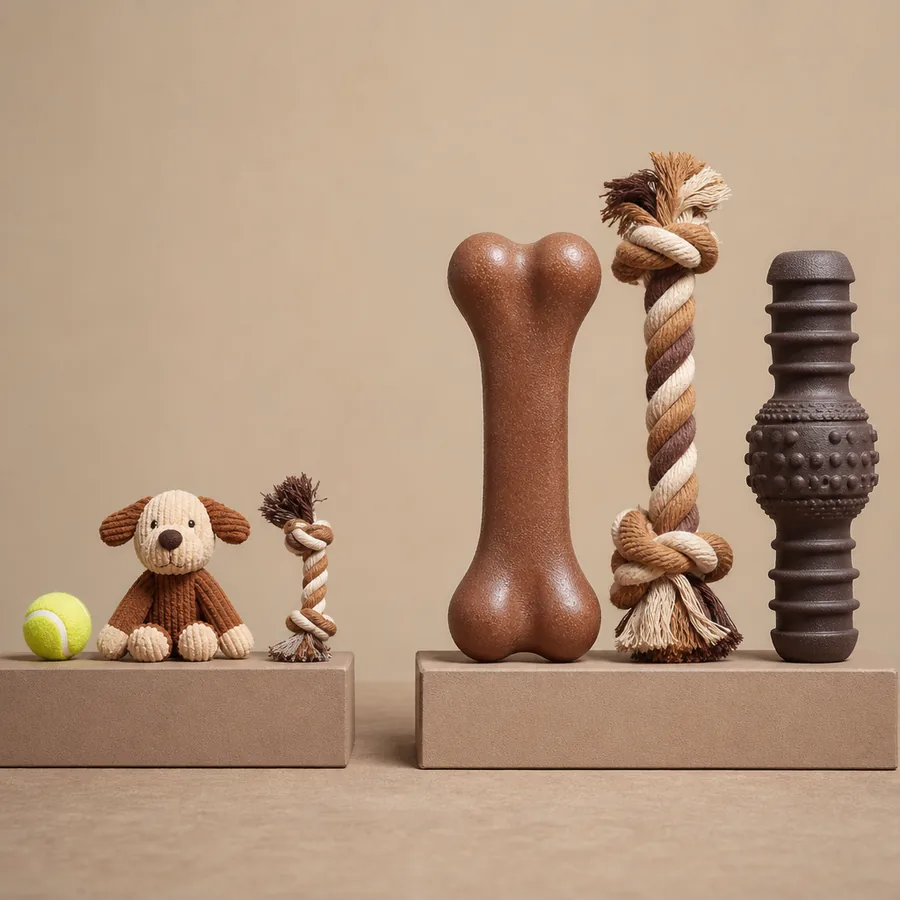
The pet toy industry has historically designed for the 20-to-60-pound dog — the Golden Retrievers, Border Collies, and Bulldogs of the world. That range represents a lot of dogs. It does not represent all of them.
The Small-Breed Problem
Toy breeds (under 12 pounds) are the fastest-growing adoption segment in urban markets. Chihuahuas, Yorkies, Pomeranians, and the exploding "micro" Doodle variants all have mouths too small for standard toy sizing. A 4-inch squeaky ball that works perfectly for a Lab is physically impossible for a 4-pound Yorkie to pick up.
Small-breed design requirements:
- Diameter under 40mm for fetch toys. A mini tennis ball should be 35–38mm. Standard tennis balls are 65–67mm. That's a different mold, different material volume, and different squeaker mechanism size.
- Plush toys under 5 inches total length. The body cavity needs to accommodate a squeaker, but the overall toy must be small enough for a toy-breed mouth. That means miniaturized 20mm squeakers and reduced stuffing density so the dog can compress it.
- Lighter materials. A 6-ounce rope toy is 10% of a Chihuahua's body weight. Small-breed rope toys need to use lighter cotton-poly blends and smaller diameters — 6mm to 8mm rope instead of the 12mm to 16mm standard.
One factory I visited in Ho Chi Minh City has a dedicated "small-breed line" running 8mm rope tugs with miniature TPR bone ends. They're producing 80,000 units per month across six private-label accounts. The demand is real.
The Giant-Breed Gap
On the other end, giant breeds (over 90 pounds) face a durability crisis. Standard "heavy chewer" toys get obliterated. A Great Dane can destroy a "durable" rubber chew rated for 60-pound dogs in under 20 minutes.
Giant-breed design isn't just about thicker walls. It's about tooling and material selection decisions at the design stage:
- Nylon density matters. Standard dog toy nylon runs at Shore D 70–75 hardness. For giant breeds, you want Shore D 80+ to resist cracking under extreme bite pressure. The jump from 75 to 80 Shore D increases material cost roughly 12–18%, but the toy survives.
- Wall thickness minimums. Rubber chews for giant breeds need 8mm minimum wall thickness in high-stress zones. Standard chews run 4–6mm. That changes mold design (cooling channels, cycle times) and material volume per unit.
- No removable parts. Zero. A squeaker that a 100-pound dog can bite through and swallow is a $3,000–$7,000 foreign body surgery waiting to happen. For giant breeds, squeakers should be molded into the TPR or enclosed behind a secondary barrier that requires factory-destructive force to access.
The numbers support the investment. The average giant-breed owner spends 2.3x more on toys annually than the average small-breed owner ($187 vs. $81, per internal data from a retailer I've worked with). They buy fewer toys, but each purchase is higher-stakes. A toy that actually lasts generates ferocious brand loyalty.
A practical development note: if you're building a new product line, include at minimum one small-breed variant (under 5 inches / under 2 oz) and one giant-breed variant (over 10 inches / over 14 oz with reinforced construction) per core SKU. The mold investment is higher upfront, but you capture purchase intent that your competitors are ignoring. Check out [WagNab's product development capabilities](/odm) if you need a partner who can handle multiple size variants on a single design.What This Means for 2027 Planning
The trends above aren't theoretical. They're visible in purchase order volumes, retail planogram decisions, and factory production schedules. Here's what to do with them.
Start enrichment-first, not plush-first. If you're building a 2027 line plan, lead with two to three enrichment SKUs. Let plush be a supporting category, not the anchor. The enrichment category has momentum that will carry through at least 2028 before competition flattens margins. Choose three colorways, not six. Minimalist aesthetics reward curation. Six colorways per SKU fragment your production runs and increase minimums. Three — a warm neutral, a muted botanical, and a dusty pastel — cover the premium retail channel without inventory bloat. Design multi-function from the ground up. Don't add a squeaker to an existing plush and call it a day. Build the toy's architecture around serving multiple sensory and functional needs simultaneously. Texture stack intentionally. If your factory's development team can't talk through the construction sequence in detail, find a factory that can. Size-inclusive isn't optional in 2027. If your core toy SKU only works for dogs between 20 and 60 pounds, you're excluding roughly 35% of the market. Add small and giant variants now, while shelf space is still available. In 18 months, this will be table stakes. Plan lead times accordingly. Enrichment toys with multiple components take longer to sample. Multi-texture designs require more assembly steps. Factor 8–10 weeks for sampling and 10–12 weeks for production on first-run SKUs with complex construction. If your factory promises 6 weeks end-to-end on a three-mechanism puzzle toy, they're skipping steps.Browse [WagNab's product catalog](/products) to see how these trends translate into manufactured product, or [explore our ODM process](/odm) if you're ready to develop your own line with a factory partner that understands where the market is going.
FAQ
Are minimalist aesthetics just a trend, or will they stick?They'll stick for the premium channel. The demographic driving this shift — millennial and Gen Z pet owners in urban markets with higher disposable income — isn't going to suddenly want neon toys. The value-tier and mass channels will retain brighter palettes, and there's money there too. But if you're building a brand for specialty retail and DTC, commit to the muted direction.
How do I know if a puzzle toy design is too complex?Test it with actual dogs before ordering production quantities. If the median dog in your test group (10–15 dogs, mixed breeds) can't solve the puzzle within 90 seconds on their third attempt, it's too hard. Frustrated dogs destroy toys. A puzzle should challenge, not defeat.
What materials hold up best for giant breeds?Nylon with Shore D 80+ hardness and minimum 8mm wall thickness in bite zones. Natural rubber with durometer 75A or higher. Avoid TPR and standard PVC for giant-breed chews — they'll shred.
Is multi-texture manufacturing significantly more expensive?Assembly labor increases 15–30% depending on complexity. But the retail price premium (typically 25–40% above single-texture equivalents) more than covers it. The real cost is in sampling time and tooling, not per-unit production.
Should I drop all my traditional plush SKUs?No. Traditional plush still moves, especially in Q4 gifting and for casual buyers. But treat it as a cash-flow category, not a growth category. The growth is in enrichment, multi-function, and size-inclusive designs.
Your Next Move
Design trends are easy to talk about. Getting them into production — with the right materials, at the right tolerances, on a timeline that hits your retail window — is the part where most brands stumble.
If you're planning your 2027 line and need a manufacturing partner who can execute on enrichment toys, multi-texture designs, and size-inclusive variants without the usual factory headaches, we should talk. [Learn more about WagNab's custom development](/odm) or [browse our ready-to-customize catalog](/products) to see what's possible.
Have a specific design in mind? Reach out. We'd rather help you build it right than watch another brand figure out material bonding the hard way.Ready to Build Your Next Collection?
From material selection to final delivery, we help brands bring pet toys to market.