Material Matters: Natural vs. Synthetic Pet Toy Materials

A buyer from a European distributor visited our factory floor last March and picked up two nearly identical tug toys. Same dimensions. Same target weight. Same intended breed size. One was 100% cotton rope with a simple knot. The other was a TPR bone bonded to a polyester rope core. He squeezed both, pulled on them, threw them across the sample room, and asked: "Which one sells better?"
Wrong question. The right question: "Which one survives six months in a German Shepherd's mouth without generating a return?"
He picked the cotton rope. Nice margins, good shelf appeal, "natural" claims on the packaging. Eight weeks later, his first batch landed in Rotterdam. Four weeks after that, returns started coming in — the rope was shedding, dogs were ingesting fibers, and one retailer pulled the SKU entirely from their online store after three complaints. The TPR hybrid product, meanwhile, posted a 1.2% return rate and generated reorders before the cotton rope's second shipment even left the factory.
Materials aren't marketing. They're the difference between a product that builds a brand and one that burns distributor relationships. If you're sourcing pet toys at scale — whether you're a brand owner, an importer, or a distributor building private-label lines — here's what each material category actually delivers.
Natural Materials: What You're Buying (and What You're Risking)
Natural isn't automatically better. It's a set of trade-offs.
Cotton Rope
Cotton rope toys are everywhere — and that's part of the problem. Low barrier to entry means factories that have no business making rope toys are selling them by the container-load.
What you're actually buying: Most budget cotton rope toys use carded cotton from generic mills — short-staple fibers that shed under tension. Decent rope toys start with combed cotton, 12- to 16-ply twist, sourced from mills that can provide fiber-length specifications. At WagNab, we spec 16-ply combed cotton with a minimum 28mm staple length. Below that, shedding becomes a guarantee, not a risk. Durability reality: A 16-ply cotton rope tug toy weighing 180g will survive roughly 3–4 weeks of daily moderate play from a 30kg dog before significant fraying begins. For a 10kg dog, it might last 8–10 weeks. The failure mode isn't usually snapping — it's progressive fiber release that creates ingestion risk. Cost range (FOB): $0.60–$1.80 per unit depending on ply count, dye process, and knot complexity. The price difference between a 12-ply and 16-ply rope is roughly $0.15–$0.25 per unit. That quarter determines whether your product survives the return window. Supply chain reality: Cotton prices swing on global commodity markets. From 2023 to 2025, combed cotton yarn fluctuated between $2.80/kg and $4.40/kg FOB China. If your factory quotes a fixed price for 18 months without an escalation clause, ask what they're cutting when cotton spikes.Natural Rubber
Natural rubber has legitimate advantages — genuinely tough, satisfying chew resistance, no plasticizer migration concerns. It also has supply-chain quirks that catch first-time buyers off guard.
What you're actually buying: Natural rubber comes from latex harvested from rubber trees (Hevea brasiliensis), 90% of which grows in Thailand, Indonesia, and Vietnam. After harvesting, the latex is coagulated, washed, and processed into sheets or blocks. For pet toys, you want SVR 3L or RSS-3 grade rubber — anything lower often comes with higher protein content that can trigger allergic reactions in sensitive dogs. Durability reality: A well-vulcanized natural rubber chew toy (Shore A hardness 70–75, approximately 250g) will last an aggressive chewer 2–5 months. The failure mode is usually chunking — pieces tearing off rather than gradual wear. Proper vulcanization (sulfur cross-linking at controlled temperature) makes the difference between a toy that wears evenly and one that breaks into hazardous pieces. Cost range (FOB): $1.40–$3.50 per unit depending on weight, mold complexity, and whether the factory runs their own compounding or buys pre-formulated rubber. The mold itself runs $3,000–$8,000 for a single-cavity steel mold. At 5,000 units, that adds $0.60–$1.60 per unit in amortized tooling. Supply chain reality: Natural rubber prices track weather in Southeast Asia. A wet season in Thailand's southern provinces reduces latex yield by 15–20%. A dry season affects it differently but produces similar shortages. Build 8–12% price flexibility into your cost models. The factory that guarantees fixed natural rubber pricing for 18 months is either eating margin they'll eventually need back, or substituting synthetic rubber without telling you.Wool Felt
Wool felt balls and shapes are having a moment in the premium segment — quiet, soft, "natural materials" story checks the sustainability box. They also come with limitations that matter at scale.
What you're actually buying: Genuine 100% wool felt — not the polyester felt blends being passed off as wool at trade shows. Carded wool fibers compressed through heat, moisture, and agitation. Merino feels nicer but costs more; New Zealand crossbred wool is coarser but denser and better for balls that need to hold shape. Durability reality: A wool felt ball (6cm diameter, 40g) will survive roughly 2–3 months of fetch and chew from a medium dog before it starts losing shape and shedding fibers. A larger ball (8cm, 70g) buys you maybe another month. They don't crack or splinter — which is the safety story — but they do degrade steadily. Cost range (FOB): $1.20–$2.80 per unit depending on size, wool grade, and whether construction is needle-felted (better durability, more labor) or wet-felted (faster production, less shape retention). Labor is the main cost driver — needle felting is time-intensive and hard to automate. Supply chain reality: Wool is seasonal. Shearing happens once or twice per year depending on region. If your factory can't name which Australian or New Zealand wool auction they sourced from, they're probably buying from middlemen who blend grades — and your quality drifts order to order.Jute
Jute has the roughest texture of the natural materials and the narrowest use case. It works for tug toys and scratching surfaces. It's terrible for anything a dog will mouth extensively — the fibers are coarse enough to abrade gums.
Durability reality: Jute rope degrades faster than cotton under moisture. A 14mm jute tug toy used outdoors will start breaking down within 10–14 days of regular play. Indoor use extends that to 3–4 weeks. The cost advantage only holds if you're selling disposable toys at volume. Cost range (FOB): $0.40–$1.20 per unit. Jute is cheap — roughly 60–70% of equivalent cotton rope pricing — because jute is a low-input crop primarily grown in Bangladesh and India with well-established export infrastructure.Synthetic Materials: Performance You Can Specify
Synthetics get a bad reputation in pet, largely because the worst examples — cheap PVC toys leaching phthalates — deserved it. But the right synthetic, properly formulated and certified, outperforms natural materials on consistency, durability, and safety documentation.
TPR (Thermoplastic Rubber)
TPR is the workhorse synthetic for pet chew toys. It's a blend of plastic (usually polypropylene or SEBS) and rubber that processes like plastic but flexes like rubber.
What you're actually buying: Not all TPR is equal. The compound matters — specifically, the styrene-ethylene-butylene-styrene (SEBS) content and the plasticizer system. Good TPR for pet toys uses food-grade white oil as a plasticizer and keeps SEBS content above 35%. Cheap TPR uses naphthenic oils or, worse, phthalate plasticizers that will fail REACH SVHC screening. Durability reality: A properly formulated TPR chew toy (Shore A 65–80, 200g) will last an aggressive chewer 4–8 months. The material can be tuned — harder Shore A values increase durability but reduce the satisfying "give" dogs want. The sweet spot for most medium-to-large breeds is Shore A 70–75 with sufficient wall thickness (minimum 5mm on any load-bearing section). Cost range (FOB): $1.00–$2.80 per unit. The raw TPR compound runs $3.20–$5.50/kg depending on SEBS content and certification level. Injection molding is fast — 30–90 seconds per cycle — so unit labor costs stay low at volume. Supply chain reality: TPR is a compound, not a raw material, so supply depends on the compounder's formulation consistency. A factory using the same compounder for 5+ years with batch-level certification is what you want. Ask for compound batch certificates with your production samples — not just the finished product test report.TPU (Thermoplastic Polyurethane)
TPU is TPR's tougher, more expensive cousin. It bridges the gap between rubber flexibility and engineering-plastic durability. You'll see it in premium chew toys marketed to power chewers.
Durability reality: A TPU chew toy (Shore A 85–95, 200g) will survive 6–12 months with a determined chewer. It resists abrasion better than TPR. The trade-off is that it's harder — less "chewy" — and some dogs lose interest because the material doesn't yield enough. Cost range (FOB): $2.00–$5.00 per unit. TPU compound runs $5.50–$9.00/kg. Mold costs are comparable to TPR. The premium pricing only makes sense for brands targeting the "indestructible" segment — and only if your marketing can justify a $15–$25 retail price point.Silicone
Food-grade silicone has been migrating from baby products into pet, and for good reason — it's inert, temperature-stable, and carries none of the plasticizer concerns that dog synthetic materials. It also costs significantly more.
Durability reality: Silicone (Shore A 40–60) works well for treat-dispensing toys and gentle chewers. For aggressive chewers, it's a bad choice — silicone tears rather than wears, and a torn piece is a bowel obstruction waiting to happen. The material shines in "slow feeder" and puzzle toy applications where biting force stays moderate. Cost range (FOB): $2.50–$6.00 per unit depending on size and whether it's compression-molded (faster, lower tooling) or LSR injection-molded (better detail, higher tooling). Platinum-cured silicone adds 15–20% to material cost but eliminates peroxide byproducts.Polyester Plush
Plush toys are the highest-volume category in pet and the most material-sensitive. Everything that goes wrong with a plush toy — seam failure, stuffing migration, squeaker exposure — traces back to material choices.
What you're actually buying: The outer fabric is almost certainly polyester (280D to 600D depending on durability requirements). The stuffing raises the real question: virgin polyester fiber, recycled PET fill, or something that's neither but claimed as both. Durability reality: A well-constructed plush toy with 600D polyester outer and double-stitched seams (minimum 4 stitches per cm, nylon thread) will survive 2–6 weeks of moderate play. The seams fail before the fabric does. Adding a mesh inner liner between the outer fabric and stuffing extends life by 30–50% for roughly $0.18–$0.35 extra per unit. Cost range (FOB): $0.80–$2.40 per unit. The labor-to-material ratio is roughly 60:40 for plush — sewing is the cost driver, which is why factories in lower-labor-cost regions can undercut on plush pricing even with equivalent materials.Hybrid Approaches: When You Don't Have to Choose
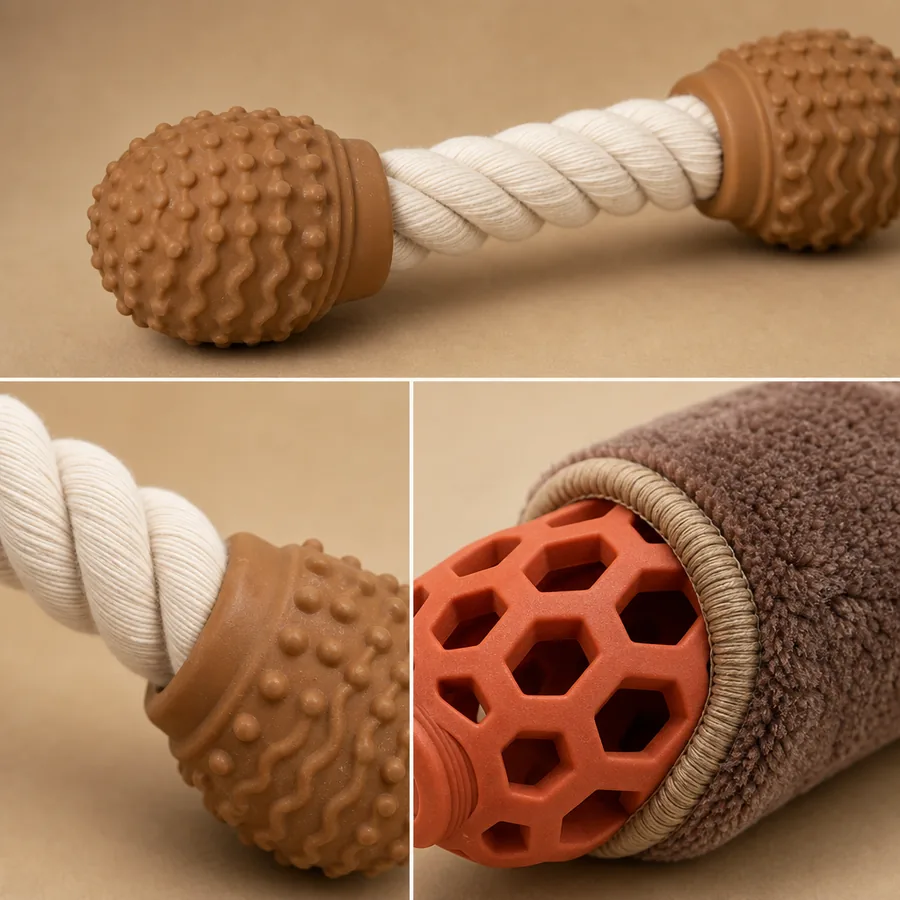
Some of the best-performing pet toys combine natural and synthetic materials for specific reasons, not just because "both" sounds good in marketing copy.
Cotton rope + TPR end caps: The rope provides the tugging texture dogs want. The TPR caps prevent the rope ends from fraying — which is where 90% of cotton rope toy failures start. Adds about $0.30–$0.50 per unit. Cuts return rates by roughly half on rope-based tug toys. Natural rubber body + polyester fleece outer: A rubber core gives chew resistance. A fleece outer gives the soft mouthfeel that sells the toy at retail. The trick is bonding — the fleece needs to be vulcanized into the rubber during molding, not glued on afterward. Glued fleece separates within days. Bonded fleece lasts the life of the toy. Jute + cotton blend rope: 60% cotton / 40% jute blends reduce material cost by 20–25% while keeping the softness profile closer to all-cotton. The jute fibers sit in the core, not the outer wrap, so the dog's mouth only contacts cotton. Requires a factory that actually layers rope construction rather than blending fibers and hoping. Plush with Kevlar-reinforced seams: For the "tough plush" segment, adding Kevlar thread to critical seam lines (mouth, ears, limbs — the points dogs target first) doubles seam life for roughly $0.25 extra per unit. It's overkill for small-breed toys. For large-breed plush, it's the difference between a toy that lasts a week and one that lasts a month.Decision Matrix: Natural vs. Synthetic
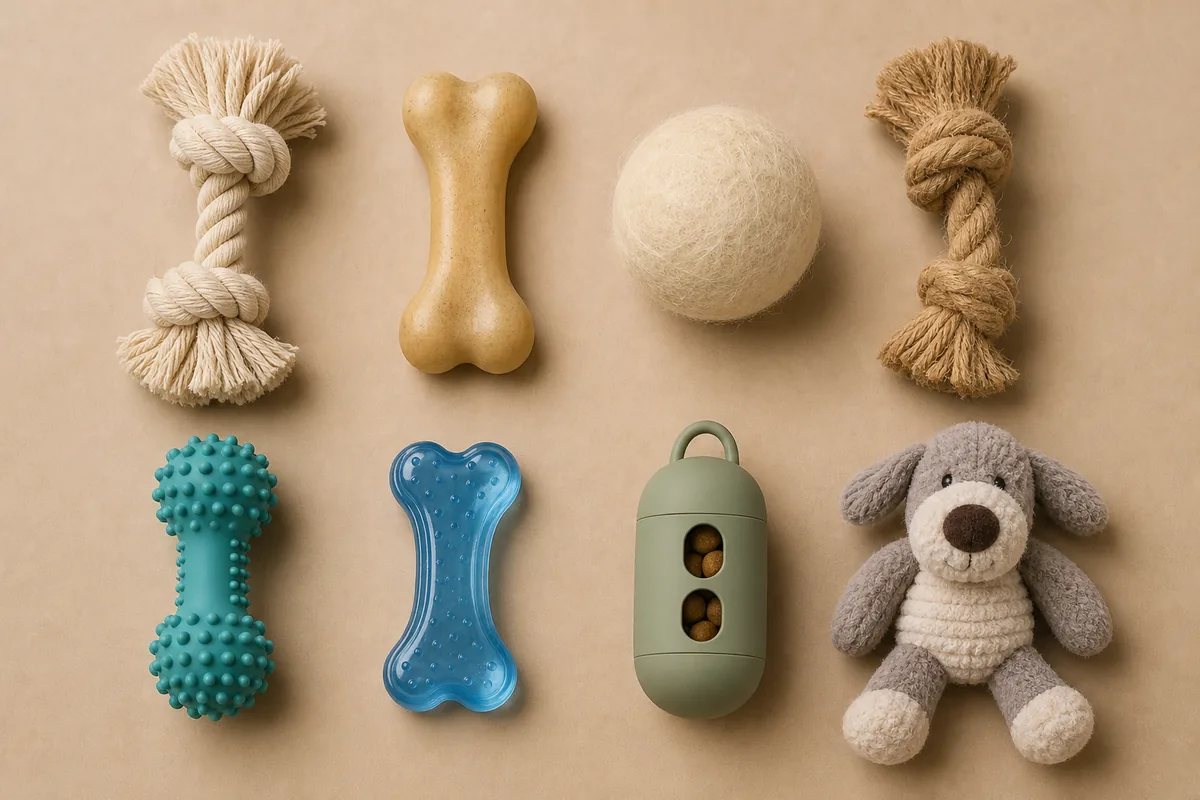
Here's how the materials stack up across the dimensions that matter in production:
| Material | Durability | Cost/Unit (FOB) | Safety Profile | Supply Stability | Best For |
|---|---|---|---|---|---|
| Cotton Rope (16-ply) | ★★☆☆☆ | $0.80–$1.80 | Good (if spec'd) | Variable (commodity) | Tug toys, small/medium breeds |
| Natural Rubber | ★★★★☆ | $1.40–$3.50 | Excellent | Variable (weather) | Chew toys, all breeds |
| Wool Felt | ★★☆☆☆ | $1.20–$2.80 | Good | Seasonal | Premium soft toys, fetch balls |
| Jute | ★☆☆☆☆ | $0.40–$1.20 | Fair | Stable | Disposable tug toys, scratchers |
| TPR | ★★★★☆ | $1.00–$2.80 | Depends on compound | Stable (compounder-dependent) | Chew toys, treat puzzles |
| TPU | ★★★★★ | $2.00–$5.00 | Good | Stable | Power-chewer toys |
| Silicone | ★★★☆☆ | $2.50–$6.00 | Excellent | Stable | Slow feeders, puzzle toys |
| Polyester Plush | ★★☆☆☆ | $0.80–$2.40 | Good (if certified) | Stable | Plush toys, all breeds |
How to read this: Durability ratings assume proper material specification. A ★★ TPR toy beats a ★★★ natural rubber toy if the TPR is properly formulated and the natural rubber is poorly vulcanized. The material itself isn't the outcome — the factory's execution of that material is.Two rules of thumb from 15 years on factory floors:
First, if your brand competes on price, go with TPR or polyester plush from a factory that runs those materials as 70%+ of their volume. Their process control on those materials will be better than a generalist factory's.
Second, if your brand competes on quality and "natural" positioning, spec natural rubber with written vulcanization parameters — time, temperature, sulfur ratio — and audit against those specs. "Natural" without process control produces returns just as fast as cheap synthetic without compliance docs.
FAQ
Which material is safest for aggressive chewers?TPU, properly formulated TPR (SEBS-based, no phthalate plasticizers), and well-vulcanized natural rubber all work. The material matters less than the design — wall thickness under 5mm fails regardless of material. Aim for Shore A 75+ hardness with no small protrusions that can be bitten off. And never silicone for power chewers — it tears rather than abrades.
Do "natural" materials actually sell better?They command higher retail prices — 15–30% premium over equivalent synthetic toys — but the return window is brutal. A natural rubber toy that chunks costs you more in returns than a TPR toy that wears evenly. Consumers say they want natural. Their purchasing behavior says they want durability. Brands that win bridge both: natural materials with synthetic-level quality control.
What's the biggest material mistake first-time buyers make?Specifying cotton rope from factories that run it as side production. Rope looks simple — twist fibers, tie knots — so buyers assume any factory can do it. The factories that do rope well run dedicated twisting lines with controlled tension and humidity. Everyone else produces rope that sheds. If rope is even 20% of your volume, find a rope-specialist factory. Don't let your plush factory "add" rope to your order.
How do I verify material claims from a factory?Three documents, every time: material composition certificate from the raw material supplier (not the factory's own letterhead), third-party lab test report for the specific material batch (SGS, Intertek, Bureau Veritas), and a production sample you can send for independent testing. If any of those three is missing, the material claim is a promise — and in pet toy manufacturing, promises don't survive customs inspection.
What about recycled materials?Recycled PET (rPET) for plush stuffing and recycled cotton-poly blends for rope are both workable — but require batch-level certification. rPET supply chains have contamination risks that virgin PET doesn't. A factory using rPET needs documented chain of custody from the recycler. If they can't name the recycler, they're probably buying from a consolidator who blends post-consumer and post-industrial waste without segregation. That's how you get a batch of "recycled" stuffing that contains something a dog shouldn't swallow.
The Bottom Line
Your material choice sets the ceiling on your product's performance before a single stitch is sewn or mold is closed. Pick the wrong material — or the right material from the wrong factory — and your marketing budget goes toward managing returns instead of building your brand.
At WagNab, we run natural rubber, TPR, and polyester plush lines on dedicated production floors with material traceability that starts at the supplier level and follows through to the batch certificate on your shipment. We'd rather tell you a material isn't right for your application than ship product we both know won't survive the return window.
The dog doesn't care about your material story. The dog cares whether the toy works. So does your customer's refund request.Ready to spec materials that match your market? [Explore WagNab's ODM capabilities](/odm) to start a material conversation with our production team, or [browse our product catalog](/products) to see how different materials perform across our existing lines.
Not sure which material fits your product concept? Reach out — we'll walk through the trade-offs for your specific breed target, price point, and distribution channel. No generic answers. Just factory-floor reality.Ready to Build Your Next Collection?
From material selection to final delivery, we help brands bring pet toys to market.