The Rise of Eco-Friendly Pet Toys: Why Sustainability Matters

I've walked through more rubber-processing facilities than I can count, and here's what I'll tell you: five years ago, if you asked a factory manager in Zhejiang about "sustainable materials," you'd get a blank stare. Today, those same managers are showing me their GRS certification binders before I even ask for coffee. Something shifted.
It's not just vibes. In 2023, Chewy reported that searches for "sustainable dog toys" on their platform jumped 47% year-over-year. Amazon's pet category saw "eco-friendly" become a top-10 search modifier for the first time. Retail buyers at Global Pet Expo 2025 were openly telling brands: show us your sustainability story or we're cutting SKU slots. This isn't a trend report — it's what I'm hearing from the distributors who actually write POs.
If you're a pet brand owner or an importer sourcing toys, you need to know what's real, what's greenwashing, and how to make sustainability work on a spreadsheet. Let's get into it.
What Actually Counts as "Eco-Friendly" in Pet Toys
Here's the problem: "eco-friendly" means nothing. It's not a regulated term. I've seen factories slap a green leaf icon on polypropylene toys and call it a day. That's not what we're talking about.
For a pet toy to genuinely qualify as eco-friendly in the B2B context, it should meet at least one of these criteria:- Material composition: At least 60% recycled, renewable, or biodegradable content by weight
- Certification-backed claims: GRS (Global Recycled Standard), OEKO-TEX, FSC for natural rubber, or GOTS for organic cotton
- End-of-life design: The product breaks down in industrial composting conditions or uses monomaterial construction that's actually recyclable
- Manufacturing process: Meaningful reductions in water usage, carbon output, or chemical inputs vs. conventional equivalents — not just "we turn off the lights on weekends"
The toy that's a polyester-cotton blend with a glued-on squeaker and a synthetic dye? Not eco-friendly, even if the hangtag shows a tree. That toy is heading to a landfill in 90 days and it'll sit there for 400 years. The math doesn't lie.
A real-world yardstick: if your factory can't produce a third-party audit trail showing material provenance back to the bale or the plantation, you're probably buying a story, not a product. I've been in the room when a major EU distributor rejected a $200,000 shipment over exactly this — the green claims didn't survive a document review. Don't be that supplier.
Materials Deep Dive: What You're Actually Buying
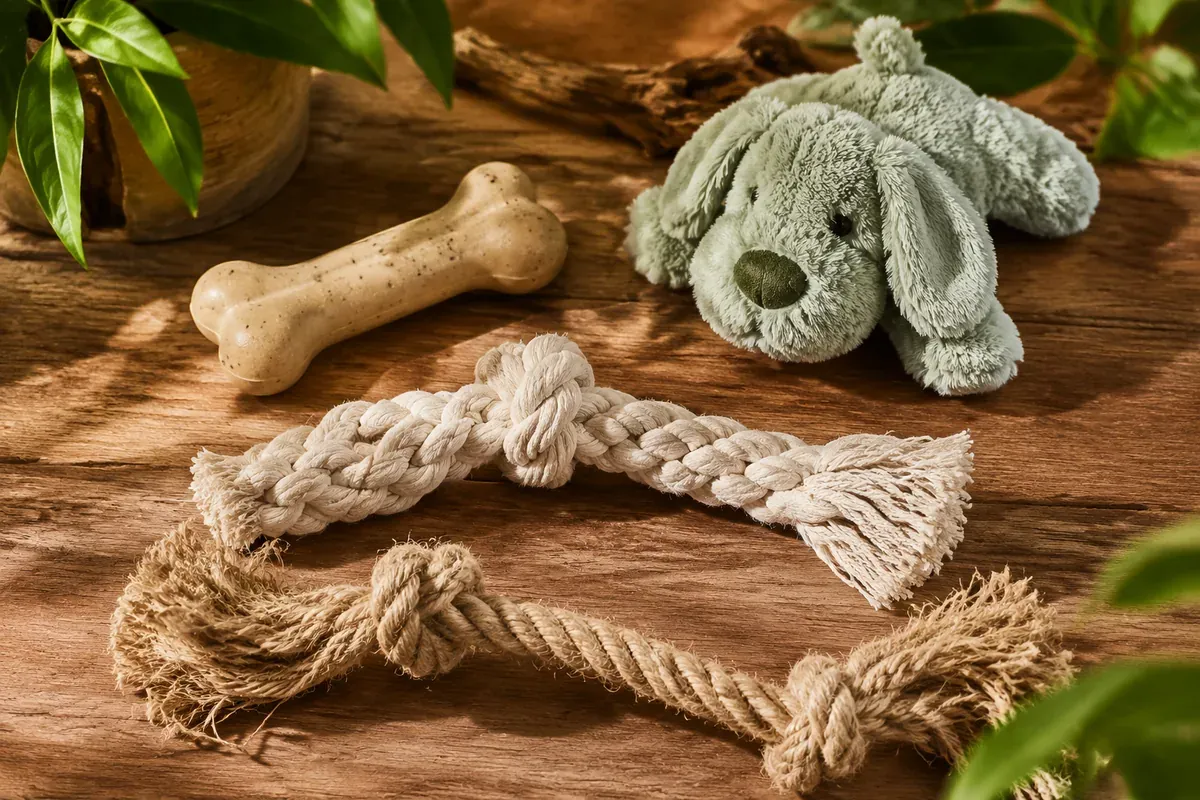
Let's talk about what's on the factory floor. I'm going to give you specifics — costs, processing realities, and the stuff most blog posts skip.
Natural Rubber
Natural rubber comes from Hevea brasiliensis trees, mostly in Thailand, Indonesia, and Vietnam. The trees are tapped (not cut down), and a mature plantation sequesters roughly 11 metric tons of CO₂ per hectare per year. That's real.
In toy manufacturing, natural rubber shows up in two forms: solid rubber (for chew toys, balls) and latex foam (for softer, squishier products). Solid natural rubber toys can hit Shore A hardness between 40 and 80, depending on vulcanization time and filler content, which gives you a broad design range from puppy-soft to power-chewer-tough.
Cost reality: natural rubber compounds currently run about $2.80–$3.40/kg at factory gate in Southeast Asia, compared to $1.60–$2.10/kg for a mid-grade TPE. That gap matters. But natural rubber molds well, takes natural pigments cleanly, and — here's the part distributors care about — it biodegrades under the right conditions. A 100% natural rubber toy buried in active soil will lose significant structural integrity within 2–3 years. A TPE toy in the same soil? Come back in two centuries.
Watch for: synthetic rubber blended in and called "natural." If the FSC certification isn't there, ask for the compound breakdown. A factory that won't share it is hiding something.
Recycled Polyester (rPET)
Most "recycled" plush toys use rPET fiber — polyester spun from post-consumer PET bottles. The process: bottles get collected, washed, shredded into flake, melted, and re-extruded into staple fiber. That fiber then gets spun into yarn for the outer fabric of squeaky plush toys.
GRS-certified rPET fiber costs roughly 15–25% more than virgin polyester at current market rates, but that premium is shrinking. In 2020 it was closer to 40%. Supply is improving fast, especially from mills in Taiwan and Korea that have invested heavily in bottle-to-fiber lines.One thing nobody tells you: rPET plush fabric has a slightly different hand feel than virgin poly. It's often a touch coarser. Your factory needs to adjust needle depth on the sewing line to avoid seam puckering. I've seen brands approve a virgin-poly sample, then reject the rPET production run because "it feels different." Specify rPET in your development samples from day one.
The environmental win is measurable: producing rPET fiber uses about 59% less energy than virgin polyester and reduces CO₂ emissions by roughly 32% per kilogram, according to lifecycle data from Textile Exchange. That's the kind of number that goes in a retail buyer's sustainability deck.
Organic Cotton
Organic cotton in pet toys usually appears as rope toys, tug components, or fabric covering for squeaky toys. GOTS certification is the standard you want — it covers both the farming practices and the processing (no toxic dyes, no child labor, traceable supply chain).
Here's the catch: organic cotton rope toys don't last as long as synthetic rope. Cotton fiber tensile strength is lower than nylon or polypropylene, full stop. A 20mm braided organic cotton tug will start fraying faster than a poly-blend equivalent. That's not a defect — it's the material. Position organic cotton toys as "gentle-play" or "supervised enrichment" products, not as indestructible chew toys. If you market them wrong, your return rate will tell you.
Cost: organic cotton yarn runs about 2× conventional cotton at the spinning mill level. For a typical 10mm × 30cm rope tug, your landed material cost might go from $0.42 to $0.78 per unit. On a 10,000-unit order, that's $3,600 additional material cost. Not nothing. But the MSRP uplift you can command for certified organic — often 30–50% — more than covers it.
Hemp
Hemp is the underdog here and honestly, I think it's underused. Hemp fiber is naturally antimicrobial, grows with minimal water and zero pesticides in most regions, and produces fiber yields roughly 2–3× cotton per acre. The processing is the bottleneck — decortication (separating fiber from the woody core) requires specialized equipment that's still not widespread in Asia's textile hubs.
Hemp rope toys have a distinct texture — rougher than cotton, with a natural beige-to-gray color range that varies by batch. Some dogs love the mouthfeel. Some ignore it. Test with a small run first.
From a sourcing perspective, China produces roughly 40% of global industrial hemp fiber, so if you're already manufacturing there, hemp can be locally sourced. Just make sure your factory has worked with it before. Hemp fiber's irregular staple length means it behaves differently on braiding machines, and a crew that's only run cotton or poly will produce inconsistent results on their first batch.
The B2B Business Case: Margins, Buyers, and Regulations
Let's get to the part that matters on a P&L.
Buyer Demand Is Not Hypothetical
I spoke with a pet retail chain buyer in the UK last quarter who told me they're now allocating a minimum 15% of shelf space to "sustainability-claimed" products, up from "basically zero" in 2021. They're not asking suppliers if they have a green line — they're asking why they don't.
On the wholesale side, European distributors are increasingly requiring EN 71-3 compliance plus a sustainability narrative before they'll even open a vendor onboarding conversation. That's not a nice-to-have. That's a gate.
The Regulation Train Is Coming
The EU's Corporate Sustainability Reporting Directive (CSRD) started phasing in for large companies in 2024 and expands through 2029. What does a European reporting directive have to do with pet toys? If your buyer is a large retailer subject to CSRD, they need Scope 3 emissions data from their suppliers. That means you. If you can't provide carbon data on your products, you become a compliance headache for your customer. And customers fire headaches.
The EU's Ecodesign for Sustainable Products Regulation (ESPR), adopted in 2024, will eventually mandate digital product passports for many consumer goods categories. While pet toys aren't in the first wave, the direction is clear. Brands that build traceability systems now will have a 2–3 year advantage.
On the safety side, nothing changes the fundamentals. Whether your toy is made from recycled ocean plastic or organic hemp, it still needs to pass [CPSIA, EN 71, and REACH requirements](/blog/pet-toy-safety-standards-cpsia-en71-reach). Lead, phthalates, and heavy metals limits don't care about your green story. A sustainable toy that fails a migration test is just a failed toy with better packaging.
The Margin Math
Here's a real worked example based on quotes I've seen in the past six months:
A standard 25cm squeaky plush (virgin polyester outer, PP filling): landed cost roughly $1.85 FOB for a 5,000-unit order.
The same design in GRS-certified rPET outer with recycled PET fiber fill: landed cost roughly $2.30 FOB. That's a 24% cost increase.
But here's the key: the rPET version consistently commands a 35–50% higher wholesale price from distributors who understand the positioning. At retail, the eco version will sit at $16.99 next to the standard version at $12.99, and the margin dollars per unit are higher on the eco SKU. You sell fewer units, you make more money per unit, and you build a brand story that opens doors the standard line can't.
That's the business case. It's not about saving the planet — though that's a nice side effect. It's about higher per-unit margin and better retailer relationships.
Three Strategies for Building a Green Product Line
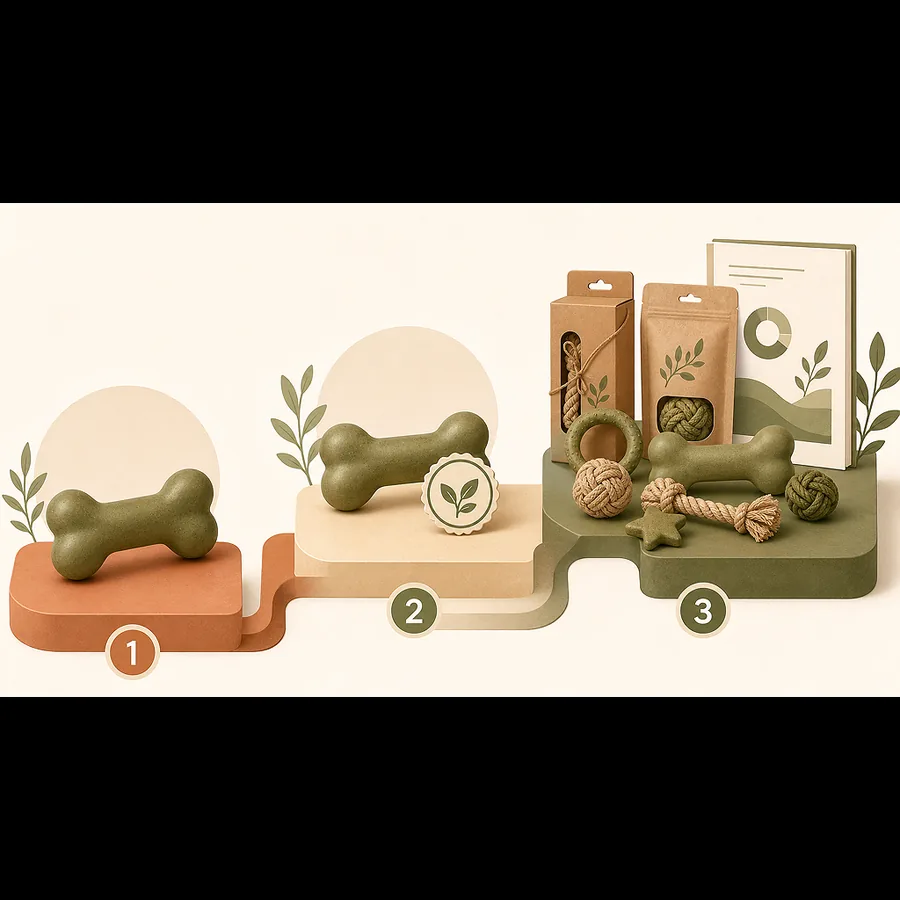
Strategy 1: The Flagship Launch (Low Risk)
Don't green your entire catalog overnight. Pick two or three SKUs — your best sellers or your highest-margin items — and develop eco versions. Use the same molds, same patterns, same suppliers where possible. Change the materials, not the supply chain. Launch them as a "Conscious Collection" sub-brand.
This approach limits your inventory risk. If the eco SKUs don't move, you've tied up capital on a few hundred units, not a few thousand. If they do move — and in my experience, they usually do when positioned right — you've got proof of concept and can scale.
Concrete example: a brand I work with launched a single natural rubber dog bone in their existing bone mold with FSC-certified compound. Same tooling, same cavity count, same cycle time. The only change was the raw material. That SKU is now 18% of their revenue after 14 months.
Strategy 2: The Certification-First Approach (Medium Investment)
If you're targeting European retail or working with a distributor who has sustainability mandates, get certified before you launch. GRS certification for recycled content, FSC for natural rubber, or GOTS for organic cotton. The certification process takes 3–6 months and costs $3,000–$8,000 depending on scope and factory count.
Do this before you print hangtags. Nothing is more expensive than recalling product because your "eco-friendly" claim can't be substantiated when a buyer's compliance team audits you.
Our [ODM service](/odm) includes certification support as part of the development process — we coordinate with third-party auditors on your behalf so you're not navigating Chinese factory documentation in a language you don't speak.
Strategy 3: The Full-Sustainability Platform (High Commitment)
This is for established brands ready to make sustainability their identity. It means: eco-materials, plastic-free packaging (FSC-certified paper hangtags, soy-based inks, no polybags), carbon-offset shipping, and a published impact report.
The packaging piece alone is worth calling out because it trips up a lot of first-timers. You spend six months developing a beautiful natural rubber toy with organic cotton rope, then ship it in a PET blister pack with a PVC insert. Your buyer notices. The irony doesn't play well on a shelf.
This strategy is capital-intensive. Plan for 12–18 months of development and a 30–50% higher COGS across the affected SKUs. The payoff: you become the brand that distributors call first when a retailer asks "who's got a sustainable toy line?"
Common Mistakes That Will Cost You Money
I've watched brands make these errors in real time. Learn from their invoices.
Mistake #1: Greenwashing by accident. You trust your factory's verbal assurance that the fabric is "recycled." No certificate, no transaction certificate, no audit trail. Then a buyer audits you, the claim collapses, and you lose the account. Always get the TC (Transaction Certificate) from the certifying body — GRS, GOTS, whatever applies. No TC, no claim. Mistake #2: Overpaying for marginal improvements. A 30% recycled content claim costs about the same to verify as a 90% claim. If you're going through the certification process, push for the highest recycled content your material performance allows. Don't pay $5,000 for GRS certification just to put "made with 20% recycled materials" on the box. Either go meaningful or don't go at all. Mistake #3: Ignoring durability in pursuit of sustainability. A dog toy that falls apart in two days is waste, full stop — no matter what it's made of. The most sustainable toy is the one that doesn't get replaced in a week. Test your eco materials for tensile strength, tear resistance, and bite-force survival before scaling production. I've seen natural rubber formulations that biodegraded beautifully in the lab and shredded on a 40-pound Labrador in 15 minutes. Test with actual dogs. Mistake #4: Leading with sustainability instead of product quality. Buyers don't buy "eco-friendly." They buy a toy their customers' dogs will love — and the eco angle is what tips the decision between you and a competitor with a similar product. Lead with design, durability, and safety. Let sustainability be the closer, not the opener. Mistake #5: Treating each eco SKU as a one-off rather than a collection. A single green toy on a shelf looks like a token effort. Three to five coordinated eco SKUs looks like a brand commitment. Buyers notice the difference, and shelf placement follows.FAQ
Q: Does "eco-friendly" actually drive purchase decisions, or is it just a nice-to-have?It drives distributor and retailer buying decisions more than end-consumer decisions — for now. A 2024 survey by the American Pet Products Association found that 41% of pet owners under 40 say sustainability influences their pet product purchases. But among B2B buyers, the number is closer to 65%. Your immediate ROI comes from getting on shelves, not from the end consumer choosing the green option.
Q: Are natural rubber toys safe for dogs with allergies?Generally yes. Natural rubber latex allergies in dogs are extremely rare compared to humans. That said, some dogs react to the proteins in natural latex. If you're marketing to the allergy-sensitive segment, note it on your packaging and consider offering a latex-free alternative. The safety standards covered in [our standards guide](/blog/pet-toy-safety-standards-cpsia-en71-reach) include material toxicity limits that apply regardless of the base material.
Q: How do I verify my factory's sustainability claims without flying to Asia?Third-party audits. Require GRS, GOTS, or FSC chain-of-custody certification from the certifying body directly — not a PDF from your factory. Ask for the scope certificate number and verify it on the certifier's public database. If you're working through an ODM partner, make sure they provide the original certificates, not summaries. A good partner handles this transparently — that's what you should expect when [choosing an ODM partner](/blog/choosing-odm-partner-pet-brand).
Q: Will eco-friendly materials affect toy safety testing?They shouldn't, if the materials are properly certified. But different materials have different chemical profiles. A natural rubber toy with plant-based pigment might behave differently in a migration test than a synthetic toy. Always run a fresh EN 71-3 or CPSIA test on the production sample, even if the material supplier provides a pass certificate. Different processing conditions (temperature, dwell time, mold release agents) can affect results.
Q: Can I mix eco and conventional components in a single toy?Technically yes, but be careful with your marketing language. If a toy has a GRS-certified rPET outer but conventional PP filling, you can't call the whole toy "recycled." You can say "outer fabric made from 100% recycled polyester." Precision matters. In the EU, the Green Claims Directive is tightening the rules on exactly this kind of partial claim — err on the side of under-promising.
Where to Start
Building an eco-friendly line isn't about picking a material from a catalog and slapping a leaf icon on the package. It's supply chain work: verifying sources, auditing factories, testing materials, and pricing it all so you actually make money.
Start small. Pick one SKU. Choose a material you can verify. Get the certificate. Test the durability. Launch it. Learn from what sells and what doesn't. Then scale.
At WagNab, we develop sustainable pet toys from concept through production — materials sourcing, certification support, safety testing, and factory management — all under one roof. No broker markups, no certificate games. You work directly with a team that knows the factory floor because we're on it.
[Browse our product catalog](/products) to see existing eco-friendly designs available for customization, or [talk to us about ODM development](/odm) if you're building something from scratch.
Your buyers are already asking. Might as well have an answer.
Looking for more on materials and manufacturing? Read our guide on [pet toy safety standards across CPSIA, EN 71, and REACH](/blog/pet-toy-safety-standards-cpsia-en71-reach), or learn what to look for when [choosing an ODM partner for your pet brand](/blog/choosing-odm-partner-pet-brand).
Ready to Build Your Next Collection?
From material selection to final delivery, we help brands bring pet toys to market.