From Concept to Shelf: The Journey of a Custom Pet Toy

A brand owner I work with showed me a timeline from their previous factory. It listed "8 weeks" for the entire development cycle — concept through production. I asked if that ever happened. They laughed. The actual first order took 23 weeks, cost $3,400 in rushed air freight they hadn't budgeted for, and arrived three days before their distributor's order cancellation deadline.
That gap between the promised timeline and reality? It's not because factories are dishonest. It's because timelines get compressed in sales conversations, and nobody walks you through the phases that eat real calendar time. This article does that. If you're planning a custom pet toy line — whether you're a first-time brand owner or a buyer expanding into private label — here's the phase-by-phase breakdown, with the numbers that matter.
The short version: plan on 14 to 28 weeks total. If anyone promises you under 12 weeks for a fully custom product with compliance testing, ask them what they're skipping. Because they're skipping something.
Phase 1: Concept & Design (2–4 Weeks)
This is the phase where most timelines look identical on paper and wildly different in practice. The difference is how specific your starting point is.
If You Have a Clear Design Brief
You walk in with: reference images of three competitor products, target dimensions (e.g., "8-inch plush with reinforced seams, internal squeaker, two colorways"), a material preference (cotton canvas exterior, recycled PET fill), and a target FOB price. In this scenario, a factory's design team can produce a technical spec sheet and digital mockup in 5–7 business days. That's the fast lane.
If You Have a Vague Idea
You walk in with: "I want something like a Kong but different, maybe with textures, and it should float." Now the factory has to play product designer before they can be your manufacturer. Expect 2–4 weeks of back-and-forth just to land on a defined concept. Factories charge for this time — either as a design fee ($300–$800) or baked into the unit price on your first order. Either way, you're paying for it.
What Actually Happens During This Phase
The factory's development team — not the sales rep, but the people who'll build your tech pack — translates your brief into a manufacturing document. This includes: material specifications by weight and grade, stitch types and seam allowances, squeaker type and placement, dimensions with tolerances (±5mm for plush, tighter for molded components), and color references (Pantone codes, not "kind of a warm green").
Don't skip the tech pack review. I've seen a brand approve a concept where the factory interpreted "reinforced seams" as single-stitch with binding tape. The brand meant double-stitched with bar-tack reinforcement at stress points. Those are different products with different costs and durability. Clarify before a single sample gets made.Timeline Realities
- Clear brief with reference products: 2 weeks
- Loose concept needing factory design input: 3–4 weeks
- Multiple SKUs developed simultaneously: Add 1 week per additional SKU after the first
At the end of Phase 1, you should have: a signed-off tech pack, approved digital color renderings (2–3 views per product), and a written sampling schedule with dates for each round.
Phase 2: Prototyping (3–6 Weeks)
This is the phase where initial enthusiasm meets physical reality. The samples that come back from Round 1 are rarely correct. That's normal. What matters is how the factory responds to feedback.
Round 1: First Physical Sample (7–14 Days After Tech Pack Approval)
The factory produces 2–3 units of each SKU using production-grade materials. These won't be perfect. Common Round 1 issues: colors are 5–10% off from Pantone references (dye lots vary), squeaker volume is wrong (too loud, too soft, wrong pitch), stitching tension is inconsistent, or the product "feels" different from what you imagined — density, hand feel, weight distribution.
You're looking for structural problems, not fine-tuning. Does the squeaker stay in place? Do seams hold under reasonable tension? Does the shape read correctly at arm's length? Save the millimeter-level adjustments for Round 2.
Round 2: Revised Sample (7–10 Days)
You've sent annotated photos with specific feedback: "Move squeaker 15mm toward center," "Switch from #69 thread to #92 on all load-bearing seams," "Darken terracotta from Pantone 17-1540 to 18-1440." A factory with a real sampling process sends back revised units that address each point. A factory that doesn't sends back what looks like the same sample with a note saying "we improved quality."
Round 2 should be close. If it's not, that's a signal. Either your feedback wasn't clear enough, or the factory's sampling team isn't equipped to iterate precisely. Either way, diagnose it now — not during production.
Round 3: Approval Sample (7–10 Days, If Needed)
Most custom pet toys need 2–3 sampling rounds. Round 3 is usually the sign-off: color, dimensions, materials, construction, and "feel" are final. These approval samples become your production reference. The factory keeps one sealed reference sample; you keep one. If a production batch doesn't match the reference, you have an objective standard — not an argument about memory.
What Prototyping Actually Costs
Sample fees range from $80–$250 per SKU per round, depending on complexity. A simple rope tug toy might cost $80 to sample. An injection-molded TPR chew with two-material overmolding might run $200–$250. Most factories credit 50–100% of sampling fees against your first production order if you proceed. Get that in writing.
Total prototyping investment for a 3-SKU line: roughly $700–$2,000 in samples, plus shipping. This is money you spend whether or not you ultimately place a production order. It's the cost of finding out whether a factory can actually execute — not just whether their catalog photos are good.Timeline Killers in Phase 2
- Holiday shutdowns. Chinese New Year (late January through mid-February) adds 2–3 weeks. Factories in Vietnam shut down for Tet. European factories close for August. If you submit samples in late January expecting a 10-day turnaround, you'll be waiting until late February.
- Material availability. If your design calls for a specific TPR compound or specialty fabric that the factory doesn't stock, add 1–2 weeks for procurement.
- Unclear feedback. "Make it better" is not actionable. "Increase stuffing density by roughly 15%, use reference sample from brand X as a benchmark for firmness" is.
Phase 3: Testing & Compliance (2–4 Weeks)
Approval samples are signed off. Now you need to prove they're safe — and that proof needs to come from an accredited third-party lab, not the factory's internal QC department.
What Gets Tested
The testing suite depends on your target market, but here's what's standard:
For U.S. retail (CPSIA-level): Lead content (90 ppm limit for surface coatings, 100 ppm for substrates per 16 CFR 1303), phthalates (6 restricted phthalates, 0.1% limit each), and mechanical hazards — torque/tension tests for small parts, sharp edges, and squeaker accessibility. A plush toy with an internal squeaker gets pulled and twisted until something fails. The squeaker must not become a separable small part. For EU retail (EN 71): EN 71 Part 1 (mechanical and physical properties), Part 2 (flammability), and Part 3 (migration of certain elements — limits on antimony, arsenic, barium, cadmium, chromium, lead, mercury, selenium). If your product touches the animal's mouth (it does), migration testing matters. REACH SVHC (EU): The Substances of Very High Concern candidate list updates every six months. Your factory's REACH declaration from 2024 may not cover phthalate restrictions added in 2025. Request a declaration referencing the current SVHC list — specifically for DEHP, DBP, BBP, DIBP, and any other plasticizers in your material composition.For the full regulatory breakdown, read [Pet Toy Safety Standards: CPSIA, EN 71 & REACH Explained](/blog/pet-toy-safety-standards-cpsia-en71-reach).
Testing Timeline and Cost
Third-party testing at an accredited lab (SGS, Bureau Veritas, Intertek, TÜV) takes 10–15 business days for the full CPSIA or EN 71 suite. Rush service (5–7 business days) adds 30–50% to lab fees.
Testing costs per SKU: $400–$900 for CPSIA basic suite, $500–$1,200 for EN 71 full suite, $300–$500 for REACH SVHC screening. A 3-SKU line targeting both U.S. and EU markets: budget $2,500–$5,000 for testing. This is not a place to economize. One failed retailer audit because testing was incomplete costs multiples of that.
What Happens When Tests Fail
It happens. A squeaker door separates during torque testing. Lead content tests at 105 ppm in a surface coating instead of the 90 ppm limit. The factory reformulates and resubmits. Add 2–3 weeks per retest cycle. This is why you don't schedule production to start the day after samples ship to the lab — leave a buffer.
One practical rule: never start production tooling until compliance testing passes. If you cut steel molds ($3,000–$8,000 per mold) and then discover a material needs reformulation that changes the mold geometry, you're paying for tooling twice. Test first, tool second.Phase 4: Production (4–8 Weeks)
Production doesn't start the moment testing passes. There's still tooling, material procurement, and line scheduling.
Pre-Production Steps (1–2 Weeks Before Units Start Coming Off the Line)
If your product requires new molds — injection molds for TPR chews, die-cut tooling for specific fabric shapes, embossing plates for brand logos — fabrication takes 2–4 weeks. Molds for a medium-complexity TPR dog chew (single cavity, steel) run $3,000–$6,000. Aluminum molds for simpler shapes cost less but wear faster on long runs. For plush toys, new cutting dies or embroidery digitization for logos adds 3–7 days and $150–$400.
Material procurement runs concurrently with tooling when possible. But if your approved materials aren't off-the-shelf for the factory — a specific TPR compound, a custom-dyed fabric, packaging with foil stamping — procurement adds 1–3 weeks. Factories don't stock everything. They order what each production run requires.
The Production Run Itself (3–6 Weeks)
Production speed depends on: order quantity, product complexity, factory capacity, and your position in the queue. A 5,000-unit order of simple rope tug toys might finish in 10 production days once the line is running. A 10,000-unit order of multi-material injection-molded treat dispensers with assembly steps could take 4–5 weeks.
During production, you should receive:
- Inline QC reports at 20%, 50%, and 80% of completion. These are photos and data from the factory floor — not curated marketing shots. You want to see random units pulled from the line, not the best ones.
- A pre-shipment inspection report following AQL sampling methodology. For plush toys, AQL 2.5 (maximum 2.5% major defects) is standard. For rubber and plastic toys, AQL 1.5. If the factory can't show you these numbers, request a third-party inspection before the container seals.
What Goes Wrong in Phase 4
Component shortages. A factory orders 10,000 squeakers from their supplier; 8,000 arrive. Production stalls for four days waiting for the balance. This happens more than factories admit.
QC failures caught late. The inline inspection at 20% should catch problems. If it doesn't, and the pre-shipment inspection flags 8% major defects on a completed order, you're looking at rework (add 1–2 weeks) or accepting substandard product (don't).
The single most useful thing you can do during production: get photos. Weekly production updates with timestamped images of your actual units on the actual production line. Not stock photos. Not "production is progressing well" in an email. Real photos from the floor, every week. If the factory pushes back on this, ask yourself why.Phase 5: Shipping & Logistics (3–6 Weeks)
Your product is boxed, palletized, and sitting in a factory warehouse. It still has to reach your distribution center or 3PL. This phase has more variables than any other — and it's the one brands underestimate most.
Ocean Freight: The Default Option
For most pet toy orders, ocean freight is the cost-effective choice. A 20-foot container from major Chinese ports (Shanghai, Ningbo, Shenzhen) to U.S. West Coast ports (Los Angeles/Long Beach, Oakland) takes 14–18 days in transit. Add 3–5 days at origin for consolidation and customs clearance, and 5–10 days at destination for unloading, customs, and drayage to your warehouse.
Realistic total: 22–33 days port-to-warehouse for West Coast. East Coast via Panama Canal: 28–35 days. East Coast via West Coast rail transload: 18–25 days but costs more.
Container costs fluctuate. As of mid-2026, a 20-foot container China to U.S. West Coast runs roughly $2,800–$4,200 depending on the shipping line and season. A 40-foot container: $4,500–$6,800. Peak season (August–October, ahead of Q4 retail) adds 15–30% to both transit time and cost.
Air Freight: When You're Out of Time
Air freight moves product in 5–8 days door-to-door. It also costs 4–6x ocean freight. A 500kg shipment that costs $600 by sea might cost $2,800–$3,400 by air. For a 5,000-unit order of 150g plush toys, the per-unit freight cost jumps from roughly $0.12 by sea to $0.55–$0.68 by air. On a $2.50 FOB product, that erases your margin.
Air freight should be an emergency option, not a planning assumption. If you're budgeting for air freight because your timeline is too tight for ocean, your timeline was unrealistic from the start.
Customs and Compliance at the Border
Your factory should provide: commercial invoice, packing list, bill of lading or airway bill, and — most critically — a certificate of compliance for the relevant standards (CPSC-accepted lab report for U.S., EN 71 test reports for EU). Products without proper compliance documentation sit in customs. Customs storage fees accrue daily. A container held for 10 days at the Port of Long Beach generates roughly $800–$1,500 in demurrage and storage charges before it's released.
I've written about factory selection and compliance in detail: [How to Choose the Right ODM Partner for Your Pet Brand](/blog/choosing-odm-partner-pet-brand). The factory vetting you do upfront directly determines whether this phase goes smoothly or turns into a logistics fire.
Total Timeline: 14–28 Weeks
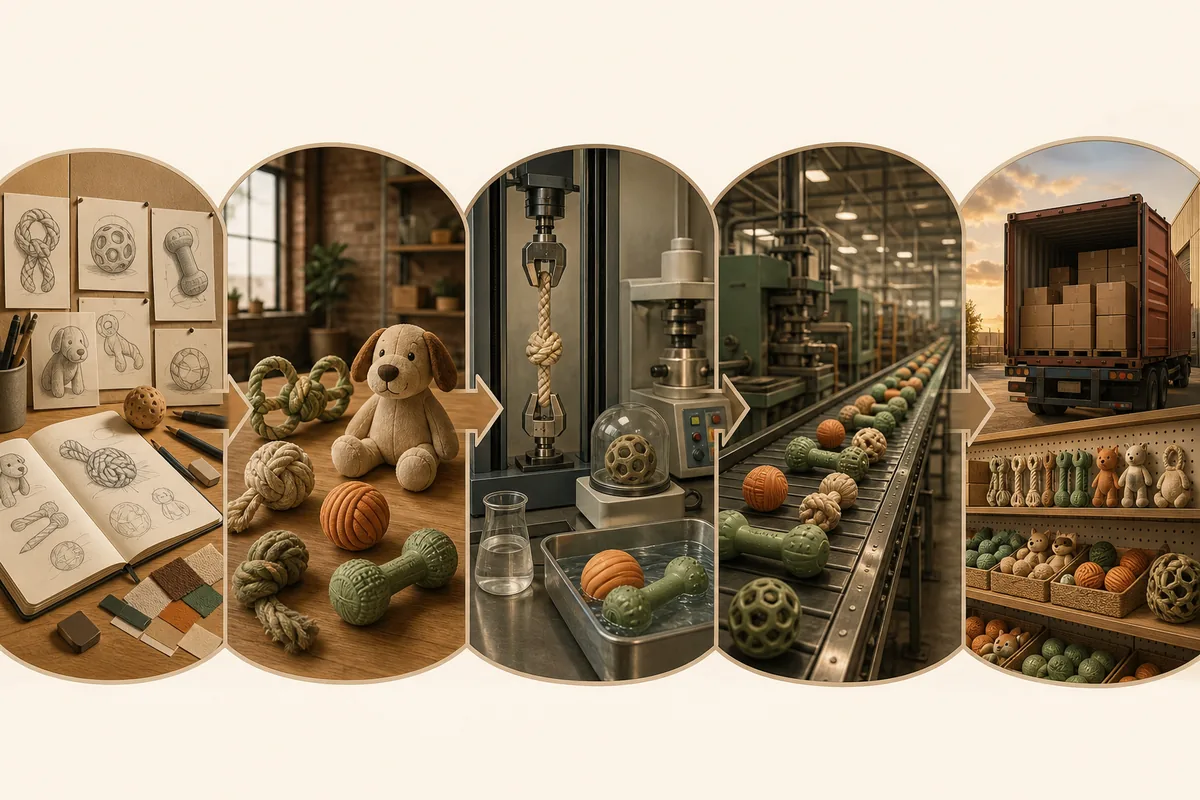
Here's how the phases stack up, with realistic low-end (everything goes right) and high-end (normal delays) estimates:
| Phase | Low End | High End |
|-------|---------|----------|
| Concept & Design | 2 weeks | 4 weeks |
| Prototyping (3 rounds) | 3 weeks | 6 weeks |
| Testing & Compliance | 2 weeks | 4 weeks |
| Production | 4 weeks | 8 weeks |
| Shipping & Logistics | 3 weeks | 6 weeks |
| Total | 14 weeks | 28 weeks |
The low-end total of 14 weeks assumes: a complete design brief on day one, first-round samples that are 90% correct, compliance testing that passes on the first submission, production that starts immediately, and ocean freight with no port congestion. That sequence has happened. It's not the norm.
The 20–24 week range is where most custom pet toy projects land. Plan for it. If you finish early, you have inventory ahead of schedule — that's never a problem. Finishing late means missed retail windows, air freight you didn't budget for, and conversations with buyers you'd rather not have.
Common Bottlenecks (And How to Avoid Them)
Bottleneck 1: The Factory Sales Rep as Information Gatekeeper
The person who answers your emails during the sales process is not the person running your production line. They're also not the sampling team, the materials buyer, or the QC inspector. When every question routes through the sales rep, information gets filtered, delayed, or lost.
Fix: Before your first purchase order, ask for direct contact with your production coordinator. Send them one question and measure response time during the sampling phase. If it's more than 48 hours during sampling, it'll be worse during production when they're busier.Bottleneck 2: Holidays You Didn't Calendar
Chinese New Year moves every year. Vietnam's Tet moves with it. Golden Week (first week of October) shuts down Chinese factories for 5–7 days. European factories close for most of August. South American suppliers slow down for Carnival and Christmas/New Year.
Print a calendar with all major production-region holidays marked before you set your timeline. Working backward from a retail delivery date without accounting for holidays is how brands end up air-freighting containers in December.
Bottleneck 3: The "One More Revision" Loop
You're on Round 3 of sampling. The product is 95% there. You request one more color tweak, one more squeaker adjustment. Each revision adds 7–10 days and $80–$200. At some point, the cost of the next revision exceeds the value of the improvement.
Have a decision rule before you start: maximum three sampling rounds. If the product isn't right after three rounds, evaluate whether the factory can execute your vision or whether your specifications need to change.
Bottleneck 4: Compliance Documentation Gaps
The factory's CPSIA certificate references a test from 22 months ago. Your retailer requires tests within 12 months. Now you're retesting during what should be production weeks.
Get current lab reports before you finalize the purchase order. Check the dates. Check that your specific materials are referenced — not "comparable materials" or "similar product line." The lab report should describe your product.
Bottleneck 5: Port Congestion and Shipping Surprises
Port of Los Angeles/Long Beach congestion happens unpredictably. A labor negotiation, a surge in holiday imports, a single container ship queued offshore — any of these can add 5–15 days to your transit time. You can't prevent port congestion, but you can budget 2 extra weeks into your shipping timeline and check with your freight forwarder about current conditions before you finalize delivery promises to buyers.
FAQ
How much does a custom pet toy cost to develop from scratch?For a single SKU: $2,000–$8,000 in development costs (design fees, samples, testing, mold tooling if applicable) before you spend a dollar on production. This doesn't include your time. For a 3–5 SKU line, budget $8,000–$25,000 in pre-production costs. [ODM products from existing catalogs](/odm) reduce this significantly — you're customizing colors and branding rather than developing from raw concept, which cuts development time to 6–10 weeks and costs to $1,000–$3,000.
Can I shorten the timeline by overlapping phases?Partially. Testing can begin while final prototype adjustments are being made, as long as the materials and construction are finalized. Tooling fabrication can begin once the design is locked, even before testing completes — but only if you're confident the materials won't change based on test results (they sometimes do). The one overlap you should never attempt: starting full production before compliance testing passes. I've seen the results. They're expensive.
What's the minimum order quantity for a custom pet toy?Factory-dependent, but realistically: 500–2,000 units per SKU for plush toys, 1,000–3,000 for molded rubber or TPR products (mold costs need volume to amortize). Some factories advertise 300-unit MOQs. At those volumes, your order is filler between larger runs — your production timeline is at the mercy of bigger clients. If you need 300 units to test a market, you're better off starting with [existing products](/products) and custom branding rather than full custom development.
How do I know if my factory is on schedule without visiting in person?Require weekly production updates with timestamped photos of your actual products on the actual line. Request raw QC data, not a summary email saying "quality is good." If the factory resists providing photos or data, treat that resistance as information. Also: hire a third-party inspection service (QIMA, Bureau Veritas, SGS) for a mid-production check. It costs $300–$500 and catches problems when they're still fixable — not when 12,000 units are already in a sealed container.
What if my product fails compliance testing?First, don't panic. It's common, especially on first submissions. The lab report will identify exactly what failed and at what level. Send the report to your factory with a clear deadline for a reformulated sample. Most failures are fixable — a different pigment, a reformulated plasticizer, a construction change. What matters is whether the factory responds with a concrete plan in 48 hours or goes silent for two weeks. Their response tells you whether this is a partnership worth continuing.
Ready to Start Your Custom Pet Toy Project?
The timeline is real. The costs are real. But so is the outcome when you work with a factory that treats development as a structured process — not a series of hopeful guesses.
At WagNab, we've guided brands through every phase described above. We provide tech pack development, structured sampling schedules with dedicated project coordinators, in-house compliance documentation support (CPSIA, EN 71, REACH), and production updates with real photos from the factory floor — not sales-filtered summaries. Our [ODM services](/odm) let emerging brands customize existing proven designs with lower MOQs and faster timelines, while our [full product catalog](/products) gives established buyers a starting point for line extensions.
Whether you're developing your first custom plush toy or expanding an existing line into molded chews, the process works when the factory treats your timeline like it matters. Let's build something that dogs love and retailers actually want to stock.
[Start your custom project](/contact) — or browse our [product catalog](/products) to see what's possible.
Ready to Build Your Next Collection?
From material selection to final delivery, we help brands bring pet toys to market.